
Margin marks
4 human-approved annotations, anchored to the article text.
I should begin by saying that I do not know anything about investing. Not in the polished, humblebrag sense where someone says they “don’t know anything” and then begins discussing basis points, discounted cash flow, or some other terms I can't conjure at the moment. I mean it more literally. I know that companies exist. I know that stocks exist. I know that sometimes a line goes up and people become unbearable. I know that sometimes a line goes down and the same people become unbearable. That is roughly the level of expertise we are dealing with.
Naturally, I decided to build software.
The original impulse was simple enough. I follow AI closely. I read a lot about models, infrastructure, robotics, sensors, chips, energy, autonomy, and the strange expanding weather system around artificial intelligence. Every week, there are new companies, new claims, new product announcements, new doom cycles, new victory laps, and new opportunities for a person like me to mistake curiosity for financial judgment. I wanted a way to turn all that reading into something more disciplined. Not a trading bot. Not a stock-picking oracle. Not a casino interface with a blue gradient and a dopamine cannon. I wanted a research system that could help me organize thoughts.
That became Signal Desk.
Signal Desk is a local AI investment research desk for learning, thesis tracking, SEC filing review, and source-linked recommendations. The phrase “research support only” is not ornamental. It does not place trades, connect to brokerages, or provide financial advice. It is deliberately allergic to the phrase “buy this now.” The idea is not to replace judgment. The idea is to build a machine that keeps me from wandering into a financial briar patch wearing a cape.
The app started from an embarrassing but useful premise: I need handholding. Not because I want an AI to tell me how to get rich. I need handholding because I do not yet know which questions matter. What is gross margin? Why does dilution matter? What does cash runway mean? How do you tell the difference between real revenue growth and one-time sugar? What does a company actually say in a 10-Q when it has to stop giving the TED Talk version of itself and start making legally binding noises in public?
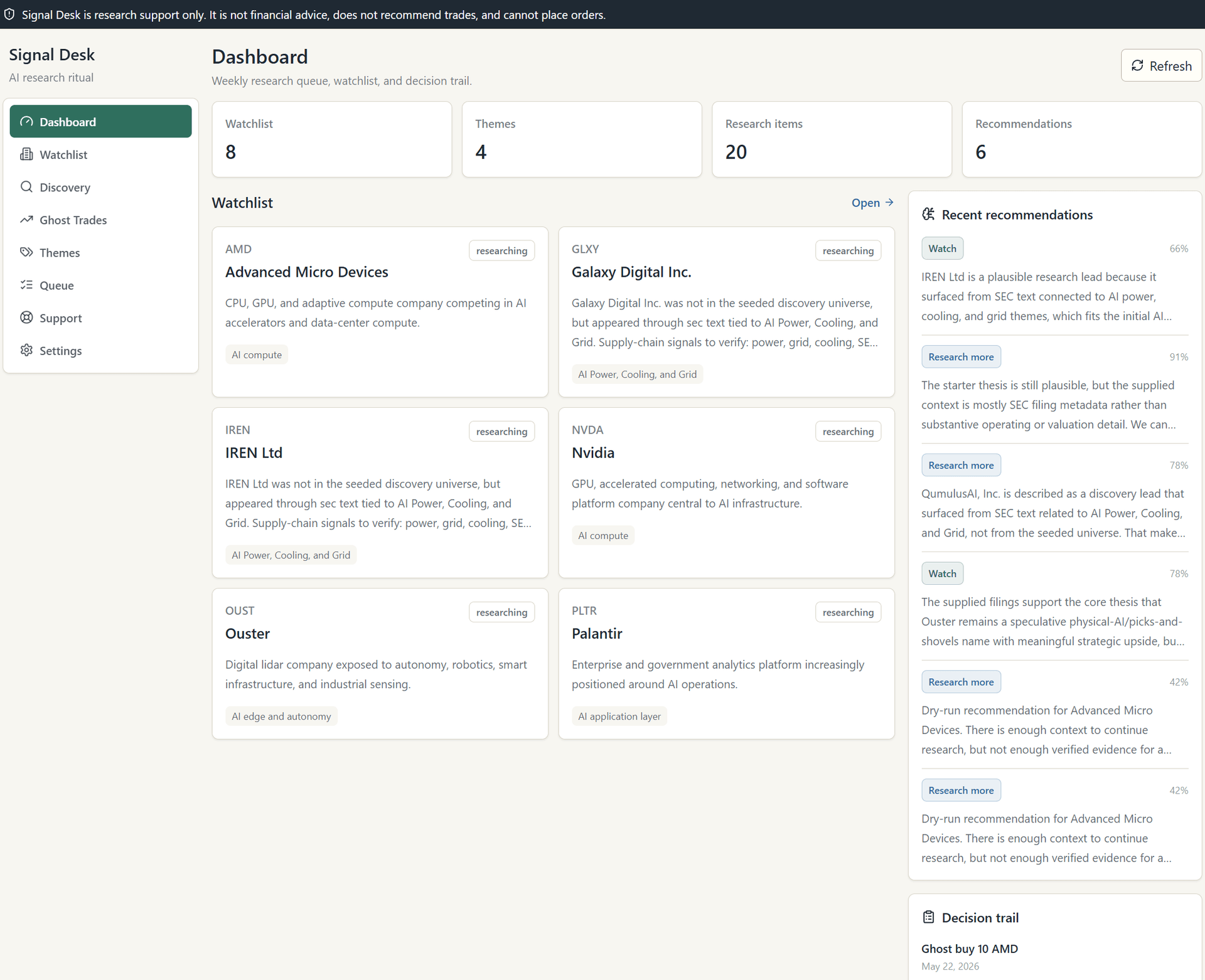
That is where the system begins to earn its keep. Instead of starting with “should I buy this stock?” Signal Desk starts with research structure. Companies get assigned to themes. Themes might include AI supply chain, physical AI, edge computing, power and cooling, advanced packaging, networking, security, or enterprise AI plumbing. Each company has a thesis card: bull case, bear case, key assumptions, invalidation signals, metrics to watch, and a current stance. This forces the first useful act of investing, which is not buying anything. It is admitting what you think is true.
The first real workflow was SEC filing ingestion. Signal Desk can resolve a ticker to a CIK, fetch recent 10-K and 10-Q filings, download filing text, store the metadata, and attach filings to a company record. The build notes show the workflow validated with Ouster, where the app resolved OUST to its CIK, stored recent filings, downloaded text, and displayed those filings on the company page. This matters because filings are where narrative goes to put on shoes. Press releases can levitate. Investor decks can glow in the dark. SEC filings are not automatically honest in the cosmic sense, but they are at least more constrained. They are where a company has to say the quiet parts in a dialect lawyers can tolerate.
Then came the AI layer. The system has provider abstraction for OpenAI, Ollama, and dry-run/local fallback. That means the AI work is not glued directly into the application like a cursed chandelier. It can summarize filings, generate recommendations, produce research briefs, and preserve source context. The documentation is explicit that recommendations are research categories, not instructions. A company can be marked as a strong research candidate, watchlist item, avoid for now, too speculative, needs more data, thesis improving, or thesis weakening. That distinction is the soul of the project. The system is allowed to say, “This deserves your attention.” It is not allowed to say, “Mortgage the shed.”
The recommendation workflow is designed to be skeptical. It should include evidence, counterevidence, risks, confidence, and “what to verify next.” That last section is probably the most important part. I do not want AI-generated certainty. Certainty is cheap. I want a list of homework assignments. If a lidar company looks interesting, I want the system to tell me to verify whether growth came from product revenue or one-time licensing revenue. I want it to flag cash burn, dilution, customer concentration, and margin trends. I want it to ask the dull, necessary questions that stand between “this is cool” and “I have purchased a narrative.”
At some point, because apparently I cannot leave anything alone, we added ghost trades.
Ghost trades are hypothetical buy decisions for validating research over time. They are paper-only. No orders. No brokerage connection. No portfolio cosplay. The system records a ticker, command, date, quantity, entry price, and valuation snapshots. It can preview a delayed close, refresh open ghost positions, and generate an AI summary of what happened between the ghost entry and the latest mark. I love this feature because it creates a sandbox for being wrong. Instead of instantly converting a hunch into real money vapor, I can log the decision and see how the idea behaves. Did the thesis hold up? Was the timing ridiculous? Did I misunderstand the company?
Discovery came next. This is where the project got more interesting. Signal Desk can scan for AI supply-chain research leads across themes like physical AI, edge, power and cooling, advanced packaging, HBM, networking, optical, AI security, and enterprise AI plumbing. Candidates are scored for research priority and can be queued as research items or promoted into the watchlist with a starter thesis. The docs are careful to say these scores are triage signals, not investment advice. That is exactly the posture I want. Discovery should surface possible rabbit holes. It should not shove me down them while shouting ticker symbols.
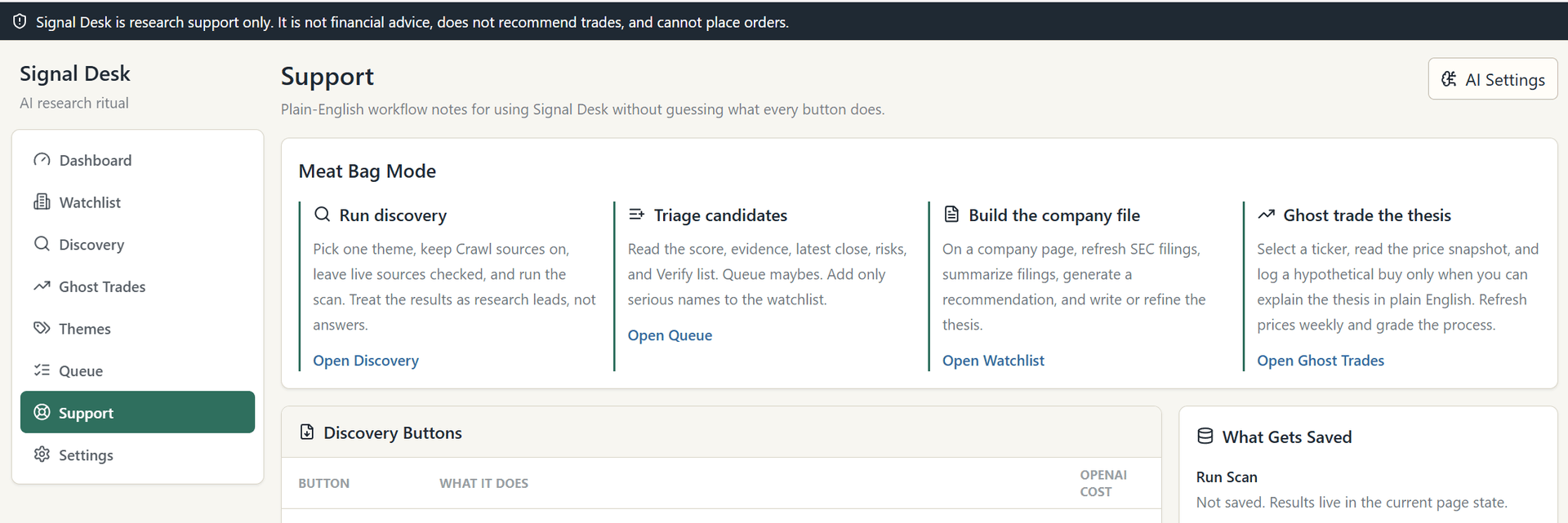
The support page and workflow documentation now describe how discovery, watchlist, recommendations, and ghost trades fit together. The app has a dashboard, company pages, thesis tracking, research items, filing summaries, AI provider settings, ghost trade validation, and discovery scans. It is still a personal tool, not a financial platform. But it is already something I did not have before: a way to convert broad curiosity into a repeatable research process.
There is a deeper reason I like building systems like this. I do not trust myself to become magically disciplined just because the subject matter is serious. Money does not make the brain nobler. It changes the conditions under which the brain operates. It introduces incentive, abstraction, status, fear, and all the tiny ideological pressures that make a person mistake market behavior for natural law. Marx understood that capital does not merely sit outside us as an object of analysis. It organizes attention. It reshapes desire. It teaches us to see risk, value, labor, and even intelligence through its own machinery.
That is the point of Signal Desk: to build friction where the surrounding system wants speed. Before I act, I want to see the thesis. I want the bear case. I want the source list. I want the risks. I want the system to ask, “What would prove you wrong?” I want a decision log so Future Me can interrogate Past Me under a bare bulb and ask whether I was thinking, or merely repeating the incentives of the room.