Margin marks
6 human-approved annotations, anchored to the article text.
You wake with the feeling before you have the facts.
Something happened. You know that much. There was a room, maybe. A blue one. Or not blue, exactly, but cold in the way blue can be cold. Someone was there, but not quite present. Far away, perhaps, though distance in dreams is rarely just distance. It might have been a hallway, or a kitchen, or water under skin. By the time you reach for the dream, the plot has already started to rot at the edges. The atmosphere remains. The sequence does not.
This is the strange theft that happens every morning. The dream does not vanish all at once. It loses grammar first.
That matters, because most ways of recording dreams ask us to do the wrong thing at the wrong moment. They ask us to write. They ask us to explain. The ask us to produce sentences at the exact moment when the dream has not yet become sentence-shaped. A dream journal assumes that the dream is already a story and that the problem is simply getting that story down before it fades.
But many dreams are not available that way. Not at first.
At first, a dream may be closer to residue than narrative. A color. A person. A bodily sensation. A room. A direction. A fragment of motion. The emotional charge can survive even after the structure collapses. You may not remember what happened, but you remember that something was late. Something was beneath. Someone was watching. The language that remains is partial, but not meaningless. It is broken in the way a fossil is broken: incomplete, but still containing remnants of the original form.
The mistake is assuming that incompleteness means failure.
A dream does not need to become a story immediately in order to be preserved. It may only need a key.
The Key is not the Dream
A few words can be enough:
blue | room | someone | far
This is not a sentence. It is not a summary. It does not tell us what happened. Still, it contains more than it seems to. There is space: room. There is presence: someone. There is distance: far. There is tone: blue. The fragment does not explain the dream, but it gives the mind several ways back in.
Rearrange the same words and the dream tilts:
someone far blue room
blue room someone far
far someone in blue room
The material has not changed, but the entry point has. "Someone far" begins with relationship and distance. "Blue room" begins with atmosphere. "Far someone in blue room" feels stranger, more dreamlike, because it refuses ordinary syntax while preserving the emotional geometry. The same words produce different doors.
That is the first clue: dream language may not behave like ordinary description. It may be less about representing an event and more about preserving access to it.
A description tries to tell the dream from the outside. A key tries to reopen it from within.
Consider another fragment:
water | under | skin | cold
Again, no complete sentence is required. "Cold water under skin" begins as sensation. It is physical, maybe environmental. "Under skin water cold" is different. Now the invasive feel comes first. The words have become less descriptive and more bodily. They press on the dream from another angle.
This is not just wordplay. It points to a larger problem in how we think about memory and language. We often imagine memory as storage: something is either saved or lost, recorded or forgotten. But dream recall seems to work less like retrieval and more like reactivation. The right cure can reopen a larger feeling and association because it does not need to contain the whole memory. It only needs to preserve enough of the memory's shape for recognition to occur. A small set of words can generate multiple structures, multiple emphases, multiple possible returns.
Chomsky's great insight was that language is not merely a list of utterances, but a system for generating meaning from finite elements. Heidegger pushes the idea further: language does not simply describe what is already present; it helps disclose a world. A dream fragment works in this stranger second sense. It does not store the dream like a file. It lets part of the dream become available again. It gives the vanished thing a place to reappear.
In that sense, the fragment is not a miniature version of the dream. It is a handle.
Before Narrative, there are roles
The most useful dream words are not useful because they are beautiful, although some of them are. They are useful because they do different kinds of work.
A dream fragment often needs a place:
room | forest | hallway | beneath | above
It may need a presence:
someone | mother | friend | she | they
It may need a body:
skin | breath | hand | teeth | blood
It may need motion:
running | falling | watching | holding | drifting
It may need atmosphere or sensation:
cold | smooth | loud | blue
It may need a state:
late | lost | calm | frantic | wrong
It may need time:
night | again | before | after | always
It may need matter:
mirror | door | water | glass | dress
These are not rigid categories. "Blue" might be visual, emotional, or environmental. "Beneath" might be spatial, psychological, or social. "Mother" might be a person, a role, an atmosphere, a memory, or an accusation wearing a cardigan. Dream language is slippery. That is the point.
Still, these word types matter because they supply different kinds of recall hooks. A purely emotional fragment may be too vague. A purely spatial fragment may be too inert. But combine a place, a presence, a bodily cue, and a state, and suddenly something begins to resonate.
mother | kitchen | light | late
There is no plot here, but there is pressure. The fragment already feels like a memory. Put "late" first and the whole thing darkens:
late kitchen light mother
Put "mother" first and the relation becomes the anchor:
mother in late kitchen light
The words imply narrative without stating one. They are pre-narrative, but not pre-meaning.
This may be why dreams can feel so powerful even when they cannot be explained. Their meaning does not always arrive as an argument. It arrives as arrangement.
Broken Grammar Still Remebers
Dreams are often grammatically unstable. So are the fragments that preserve them.
teeth | falling | hand | mirror
“Teeth falling in mirror hand” is bad prose, but it is not useless language. In fact, its awkwardness may be part of its force. It preserves the dislocated logic of the dream better than a polished sentence would. A clean sentence might make the dream legible too quickly, sanding away the wrongness that made it memorable.
A polished version might read:
I looked in the mirror and saw my teeth falling into my hand.
That is clearer, but it is also smaller. It turns the dream into an incident. The fragment keeps it unstable:
mirror hand teeth falling
Now the mirror, the hand, and the falling teeth coexist without settling into a single perspective. Are you seeing yourself? Holding the teeth? Watching a reflection? Is the hand yours? The fragment does not decide. It holds the uncertainty open.
That openness is not a defect. It may be closer to the dream itself.
The same is true of motion:
forest | running | dark | breath
“Running through dark forest breath” carries urgency. “Dark forest running breath” gives the setting more power. “Breath running dark forest” makes the body and the landscape blur into each other. None of these are complete descriptions, but each one preserves a different path back into the experience.
This is where dream language begins to resemble poetry, not because it is decorative, but because it is compressed. It depends on juxtaposition, sequence, omission, and resonance. A dream fragment does not have to say everything. It has to keep the right things close enough together.
The Problem with Explaining Too Soon
Interpretation is tempting. Humans are meaning-hungry creatures. We wake from a strange dream and immediately want to know what it means. Was it anxiety? Grief? Desire? A warning? A digestive midnight opera staged by the unconscious?
Maybe. Maybe not.
The trouble is that interpretation can arrive too early. If we force a dream into explanation before we have preserved its living material, we may replace the dream with our first theory about it. The interpretation becomes a lid.
This is especially risky because dreams occupy such an unstable place in modern life. We treat one as nonsense, another as psychological evidence, another as comedy, another as a message from some deeper chamber. The same person can move between all of these positions before breakfast. That inconsistency is not hypocrisy. It is part of the territory. Dreams do not sit inside one shared framework of meaning.
So perhaps the first task is not to decide what a dream is. The first task is to keep it available long enough for multiple meanings to remain possible.
That requires a different relationship to language. Not language as conclusion. Language as preservation.
Not “Here is what the dream meant.”
More like:
blue | room | someone | far
A small altar of words. A string tied around a vanishing thing.
From Capture to Re-entry
Once a fragment exists, it can be returned to. That return matters.
A dream that felt inaccessible at 7:04 a.m. may loosen later in the day. You see the words again:
blue | forest | someone | running

And another piece appears. Water. Beneath. Cold.
Now the fragment changes:
someone | running | beneath | cold | water | in | blue | forest

This is not merely adding detail. It is changing the structure of the remembered dream. The dream becomes less about running through a forest and more about submersion, distance, pursuit, or observation. Later still, another set of words may arrive:
still | distant | watching
Now the dream tilts again:
someone watching distant and still beneath cold blue forest water

The motion recedes. The observer appears. The emotional distance increases.
This is how dream memory often behaves: not as a single recovered object, but as a cluster of partial reconstructions. A feeling resurfaces. A new image appears without context. A word that seemed right in the morning feels incomplete by afternoon. The dream is not captured once. It is approached repeatedly.
The fragment makes that possible because it does not pretend to be final.
A Bridge to Images
There is another reason to treat dream fragments as structured language rather than raw description: they can become generative.
A fragment like:
hand | beneath | cold | water
is not just a prompt. It is a small semantic object. “Hand” gives the image a bodily anchor. “Beneath” gives it spatial orientation. “Cold” gives it tone. “Water” gives it material and atmosphere. The words do not merely describe content. They assign forces.
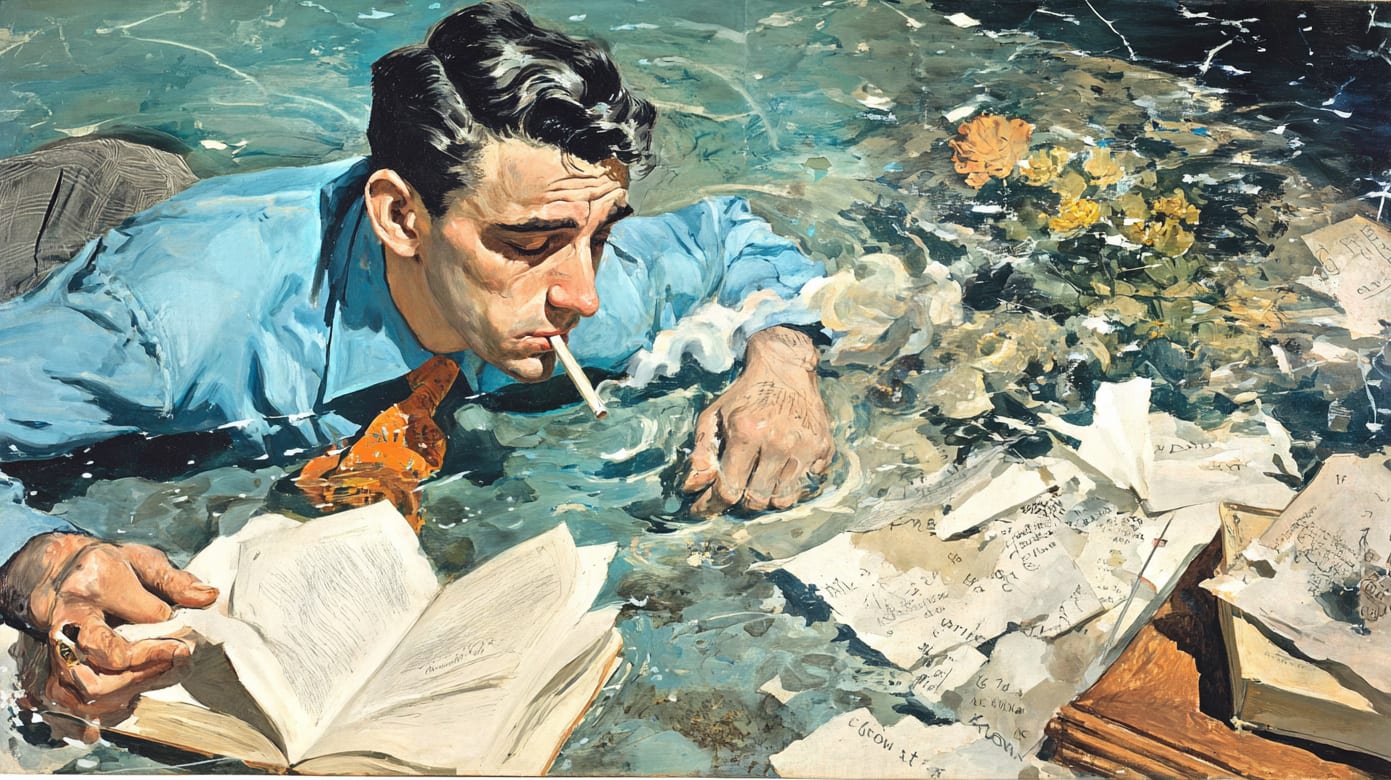
A literal rendering would miss the point. The goal would not be “draw a hand under cold water” in the most obvious way possible. The goal would be to preserve the ambiguity: a form resembling a hand, partially obscured; refracted light through a fluid surface; muted, cool tones; an uncertainty about whether the viewer is above the water or inside it.
That matters because dream images are rarely literal illustrations of dream sentences. They are interpretations of fragments. They emerge from the tension between what is specified and what remains unresolved.
This is where language becomes more than capture. It becomes a bridge between recall and transformation.
But even then, the words remain primary. The image is not the dream either. It is another key, another reconstruction, another surface where recognition might happen.
The dream before the story
Before a dream becomes a story, it is something stranger and more fragile.
It is blue without explanation.
It is a room with someone far inside it.
It is cold water under skin.
It is a mother in late kitchen light.
It is teeth, falling, hand, mirror.
It is forest, running, dark, breath.
These fragments are not failures of language. They may be the first language dreams offer us.
The work, then, is not to rush the dream into coherence. It is to meet the dream at the level where it still exists. To preserve the residue before it is disciplined into a report. To let words act as handles, not verdicts. To leave enough ambiguity intact that the dream can keep breathing.
A dream does not have to become a story immediately to survive.
Sometimes it only needs four words and a way back in.