
When people hear the word classification, they often think of tagging: a useful but secondary exercise that helps organize content after the real work is done. The real challenge is not just collecting more data, but creating a consistent interpretive layer that allows diffuse activity to be understood in a shared frame.
Without that layer, the platform can store artifacts. It cannot interpret them very well.
This matters because the source material is inherently messy. Publications, abstracts, grants, investigator activity, institutional affiliations, event participation, and other research signals do not arrive in a single scientific “language.” One record may emphasize disease area. Another may center on method. Another may reflect funding context. Another may reveal participation behavior. All of those may be relevant, but without a classification layer they remain difficult to compare and even harder to aggregate into something strategically useful.
This is where the architecture starts to matter.
In the model our team has been developing, Snowflake is not simply a warehouse for storing scientific and operational records. It serves as the shared analytical layer where those records can be normalized, related, and enriched in a consistent way. That makes it a natural place to persist classification output alongside source data, so downstream models, reporting, and decision support can operate against the same structured scientific framework.
At a high level, the pattern is straightforward. Source records enter the system with their native metadata and, where available, unstructured text such as titles or abstracts. A classification workflow then interprets that text and assigns structured outputs: scientific domain, field, subfield, topics, keywords, and confidence and ranking metadata. These outputs can then be written back as structured attributes that downstream models can actually use.
Once that happens, the warehouse stops behaving like a repository of disconnected artifacts. A publication can be interpreted in the same broader scientific frame as related grants, abstracts, investigator profiles, or event signals. Topic activity can be aggregated over time. Signals from different systems can be compared in a common vocabulary. And downstream analysis becomes less dependent on isolated records and more capable of recognizing patterns.
That is why our team has come to view classification as an architectural layer rather than a cleanup step.
Before moving that pattern into the production Snowflake environment, we are testing it in a smaller local stack built around relational storage (Postgres), vector retrieval (Qdrant), and a lightweight orchestration layer. The purpose is to validate that the workflow can produce structured scientific outputs that are inspectable and, importantly, tied back to source context. Running this work locally also makes it possible to iterate on the classification pattern without turning early experimentation into an expensive warehouse exercise.
At a tooling level, the workflow is fairly simple. OpenAlex source records are loaded into Postgres so the metadata can be queried in a structured way. Embeddings are then generated using an off-the-shelf model (Nomic) and stored in Qdrant to support vector-based retrieval across the topic space.
One important design choice is that the workflow does not simply inherit existing topic assignments and treat them as the answer. The point is to test whether the system can parse the raw text of the original abstract, compare that interpretation against the surrounding hybrid data environment, and return structured JSON identifying keywords, topics, confidence scores, and related classification signals.
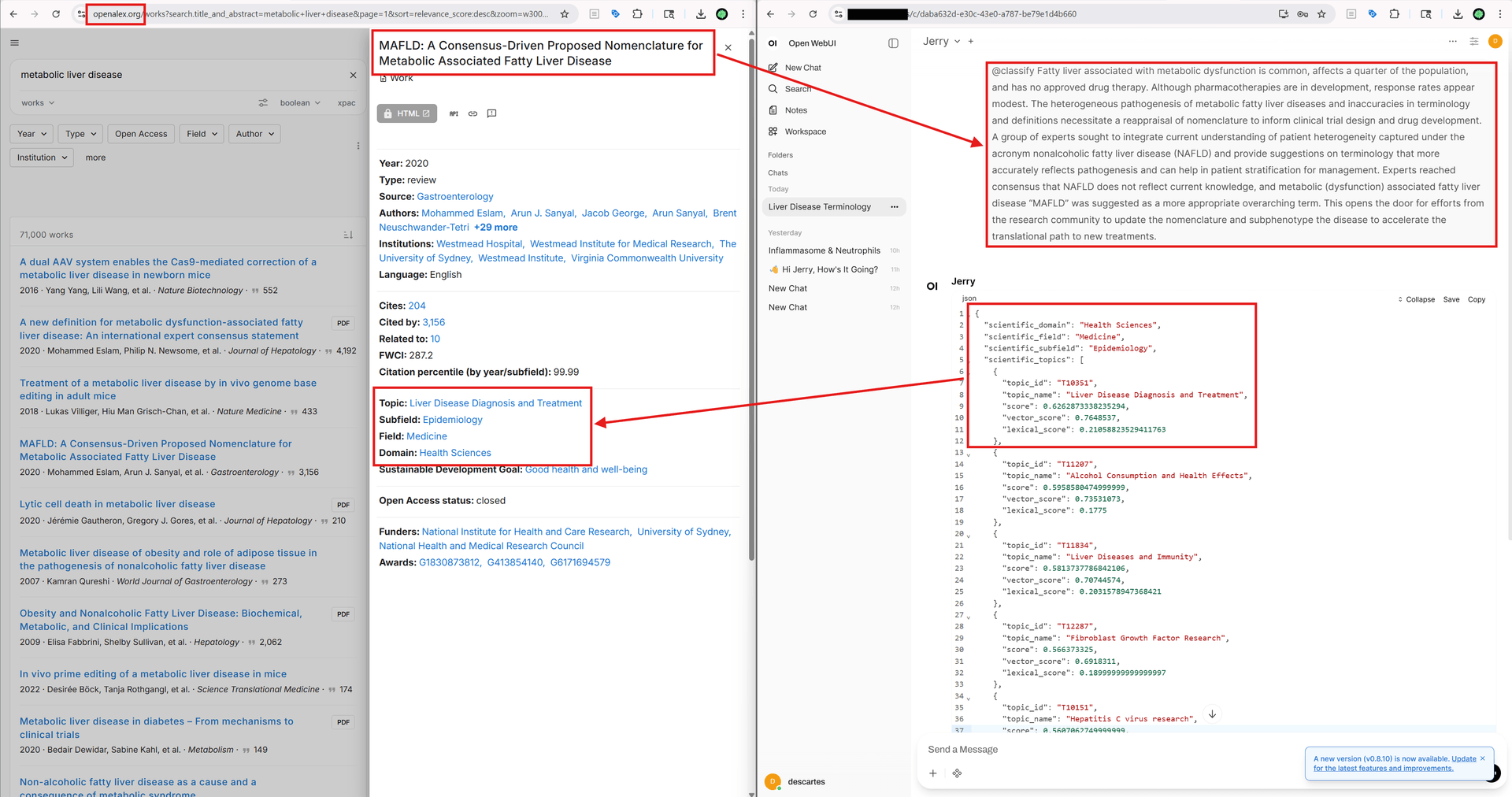
A screenshot of the validation workflow, with OpenAlex.org on the left, and a classification example on the right.
That validation approach is intentional. The goal is not just to produce plausible labels. It is to see whether the outputs remain inspectable and traceable: back to the source abstract itself, back to the structured metadata in Postgres, and back to the broader topic context surfaced through Qdrant. If that pattern holds, then the classification layer starts to look less like a black box and more like a usable enrichment workflow.
What this work is helping clarify is that the value of classification is not simply that it can assign topics to text. The value is that it can create a structured scientific layer that is inspectable enough to trust, flexible enough to refine, and durable enough to support downstream analysis. For our team, that is the important threshold: once the enrichment pattern reaches that point, it begins to look less like a labeling exercise and more like a viable architectural layer inside a larger business intelligence system.
That is what makes the enrichment layer valuable in a conference context. It creates a more structured basis for deciding which scientific areas may warrant earlier attention, where communities may be converging, and how planning can become more evidence-based over time.