Margin marks
6 human-approved annotations, anchored to the article text.
The first rule of sandwich betting is that you have to say it with the reckless abandon of a man who has never once been held accountable for lunch.
Not mild-mannered confidence. Not "I think this might happen." That is not how civilization advances. A proper sandwich bet requires a level of certainty that would embarrass a serious person. You have to be watching a football game, or sitting in a meeting, or listening to someone describe a plan that clearly will not survive contact with reality, and say something like, "No, absolutely not. I'll put a sandwich on it."
This is not something I invented. People have been making petty little wagers forever. Lunch, coffee, beer, pride, chores, or the good controller without the drift. The form changes, but the social mechanism is ancient. Someone makes a claim. Someone else resists. The air gets slightly more interesting. Then a small object is placed between them and the claim becomes real.
The sandwich is a particularly good object for this. It is small enough to be funny and real enough to matter. Nobody should ruin their life over a sandwich. Nobody should have to call their bank. Nobody should need a lawyer, a sportsbook, a compliance department, or a responsible gaming footer. But at the same time, a sandwich is not nothing. A sandwich has some weight, or should. A sandwich has cost. A sandwich has moral force.
The problem with making sandwich bets is that everyone is very confident in the moment and absolutely useless later.
Memory, in this context, is a criminal enterprise. The winner remembers justice. The loser remembers ambiguity. The winner remembers an ironclad agreement, witnessed by God and probably two other people who were not listening. The loser remembers "something more casual." Nobody remembers the exact terms. Nobody remembers whether chips were included. Nobody remembers if the wager was an Italian sub specifically, or just "a sandwich," which some people will later try to parlay into burrito law. Nobody remembers whether the deadline was Friday, the end of the meeting, or "eventually."
I have made enough sandwich bets to know this personally. Maybe a real-world example will help.
"I guarantee the Broncos will lead the entire game, lose it all in the fourth quarter, and then win with a walk-off field goal," I say.
The counterparty considers this.
"I don’t know, man. It’s just the Titans. The Broncos should destroy them."
"Fine," I say. "I’ll put a sandwich on it."
Both parties proceed to watch the Broncos win with a walk-off field goal, and then... usually nothing.
The bet is forgotten, or worse, there is no mechanism to enforce fulfillment. I have almost certainly won countless sandwiches that were never delivered. I have almost certainly lost a small number of sandwiches that I conveniently forgot. I am not proud of this. I am simply reporting from the field.
My first thought was to make a spreadsheet, which tells you two things: one, the problem was real enough to need a system; two, the system was already in spiritual decline. But a spreadsheet was wrong. A spreadsheet can remember the debt, but it cannot preserve the ceremony. It cannot file Qualms. It cannot generate useless odds. It cannot make anyone feel, even briefly, that accountability has entered the institutional phase.
At some point I realized the missing object was not merely a tracking or payment system. Spiritually, it was a napkin. A napkin is where the terms should have gone. The claim. The counterparty. The sandwich. The rider. The deadline. Maybe a fully notarized witness signature. Sandwich Bets is basically that napkin turned into software.
That is the origin, which is a little disappointing if you were hoping for a founding myth. There was no brainstorm. No pitch deck. No total addressable market for deli-based obligations. Just the recurring experience of putting sandwiches on things and then watching the entire moral structure evaporate because nobody wrote anything down.
The app records the claim, names the counterparty, preserves the stakes, and remembers who owes whom lunch. That would probably be enough. But unfortunately I live in the modern world, where every human behavior must eventually be forced through the language of markets, platforms, streaks, incentives, engagement, and other words that make me want to walk into the woods.
So naturally the app also has odds.
The odds are fake. Completely fake. Decorative. They do not affect the payout, because the payout is always one sandwich. That is the whole point. You can be +180, -240, spiritually doomed, statistically blessed, or favored by an unrelated market about whether a video game will be released on time. It does not matter. If you lose, you owe a sandwich.
I like this because it exposes something I find increasingly stupid about the world we have built. We are surrounded by fake precision. Numbers placed on top of vibes. Confidence intervals for guesses. Dashboards for anxiety. Apps that transform a feeling into a line chart and then ask whether you would like notifications enabled.
In Sandwich Bets, the odds can be based on anything. GTA VI release confidence. Office printer stability. Geopolitical vibes. Broncos optimism. The app performs expertise while refusing to be useful. That feels more honest, somehow.
The broader irritation here is gambling in general, but not only gambling. I do not mean gambling in the old sense, where someone makes a bad decision and then has to live with the consequences. I mean the modern version, where every surface of life gets optimized into a habit loop by people who know exactly what they are doing.
There is a line people like to quote: "There's a sucker born every minute." It is usually attributed incorrectly, which feels appropriate, because the line itself is inaccurate.
Suckers are not born. They are made.
They are produced by systems that study boredom, status, loneliness, hope, anxiety, and reward. They are produced by marketing teams that learn the shape of your nervous system and then quietly build a room around it. They are produced by push notifications and streaks and boosted odds and limited-time offers and "risk-free" bets that are never really free because the risk was never only money. The risk was attention. The risk was habit. The risk was becoming the kind of person who checks back.
People like stakes. That is not the problem. People like prediction, ritual, rivalry, being right in public, being wrong in public if the punishment is funny enough (looking at you, fantasy football). I like all of that. A lot of social life depends on tiny, mostly harmless forms of accountability. The crime is not that people enjoy stakes. The crime is that companies learned how to industrialize that enjoyment until it became compulsion with a brand guide.
That is why the one-sandwich limit matters.
No cash. No casino. No wallet. No deposits. No cash-out. No escalation. No "boost." No "parlay." No second sandwich because the app detected heightened engagement. One sandwich max. Maybe chips, if all parties consent and the rider is cleanly documented.
This is not because sandwiches are morally pure. They are not. I have seen what people do with mayonnaise. But the sandwich puts a hard ceiling on the stupidity. It keeps the ritual and caps the damage at lunch.
The more I worked on it, though, the more obvious it became that the app was not really about betting. That was just the entry point. The app is actually about gifting.
This was irritating, because I had already spent a lot of time making jokes about decorative odds and deli default risk.
But it is true. The bet is the excuse. The sandwich is the gesture.
If someone owes you a sandwich, what they really owe you is a small act of attention. They have to remember. They have to know what kind of sandwich can actually reach you. They have to understand whether you live in a city with a modern delivery infrastructure or, like some of us, in a mountain zone where the term "nearby" can be interpreted wildly. They have to make lunch enter the world.
That changes the product. A ledger is useful, but incomplete. Fulfillment is where the joke either becomes real or dies. If the app makes it easy to send meal credit, pick a viable service, schedule a sandwich appearance, or acknowledge that the sandwich was actually received, then it is not just enforcing debt. It is helping people complete the social gesture they agreed to.
There is something nice about that.
The design followed the same logic. At first I wanted it clean, because I always want clean and minimal UI. Minimal interface. Nice typography. A little sandwich stack. Very tasteful. And very doomed.
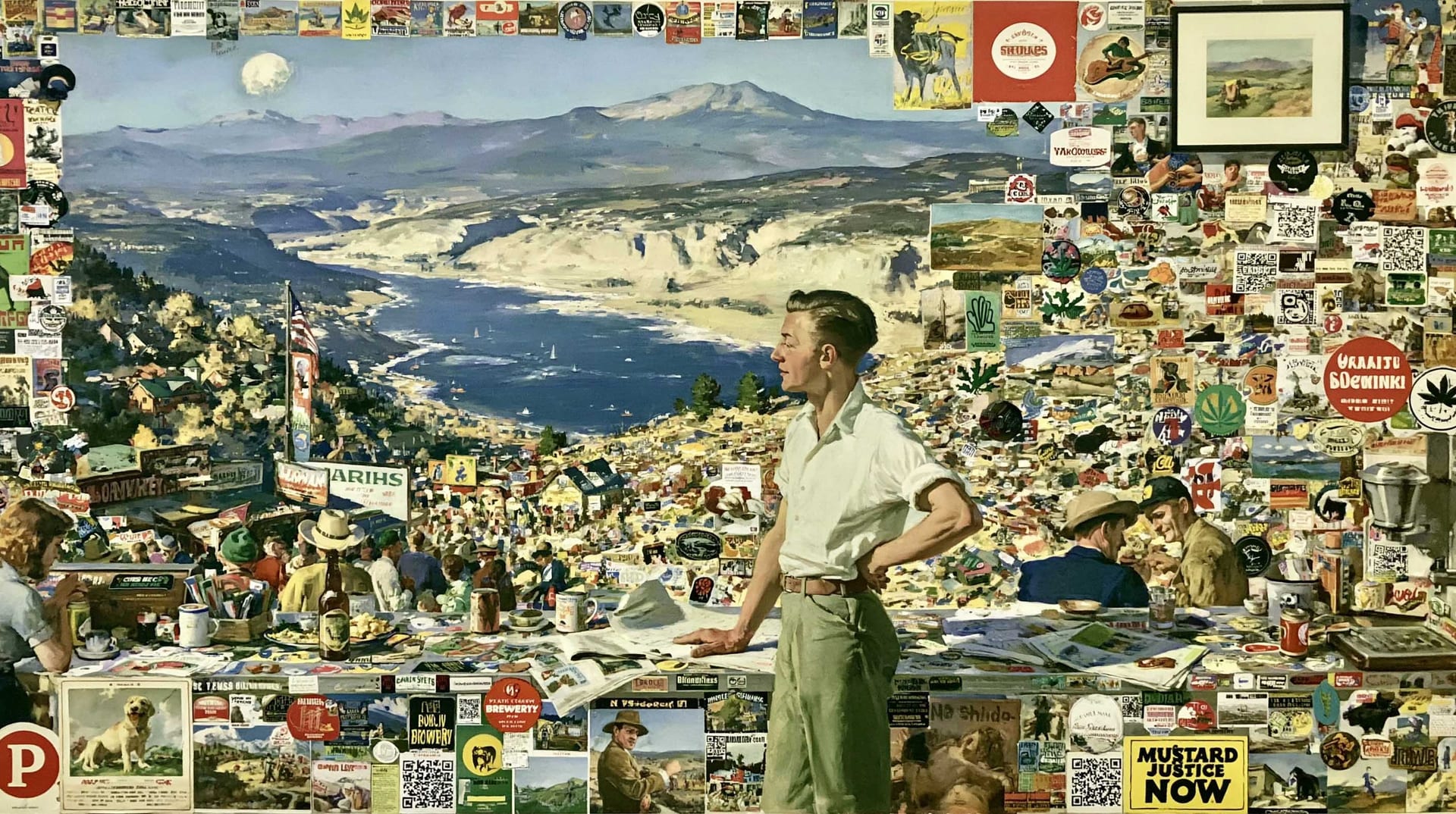
Then I started thinking about where I actually go for sandwiches up here in the mountains. Sticker-bombed deli walls. Not designed sticker walls. Real ones. The kind you see on coolers, ski lifts, water bottles, bikes, stop signs, laptops, and, importantly, sandwich shops in mountain towns. The original surface disappears under layers of local bands, bad slogans, breweries, ski shops, abandoned political movements, and/or Space Balls.
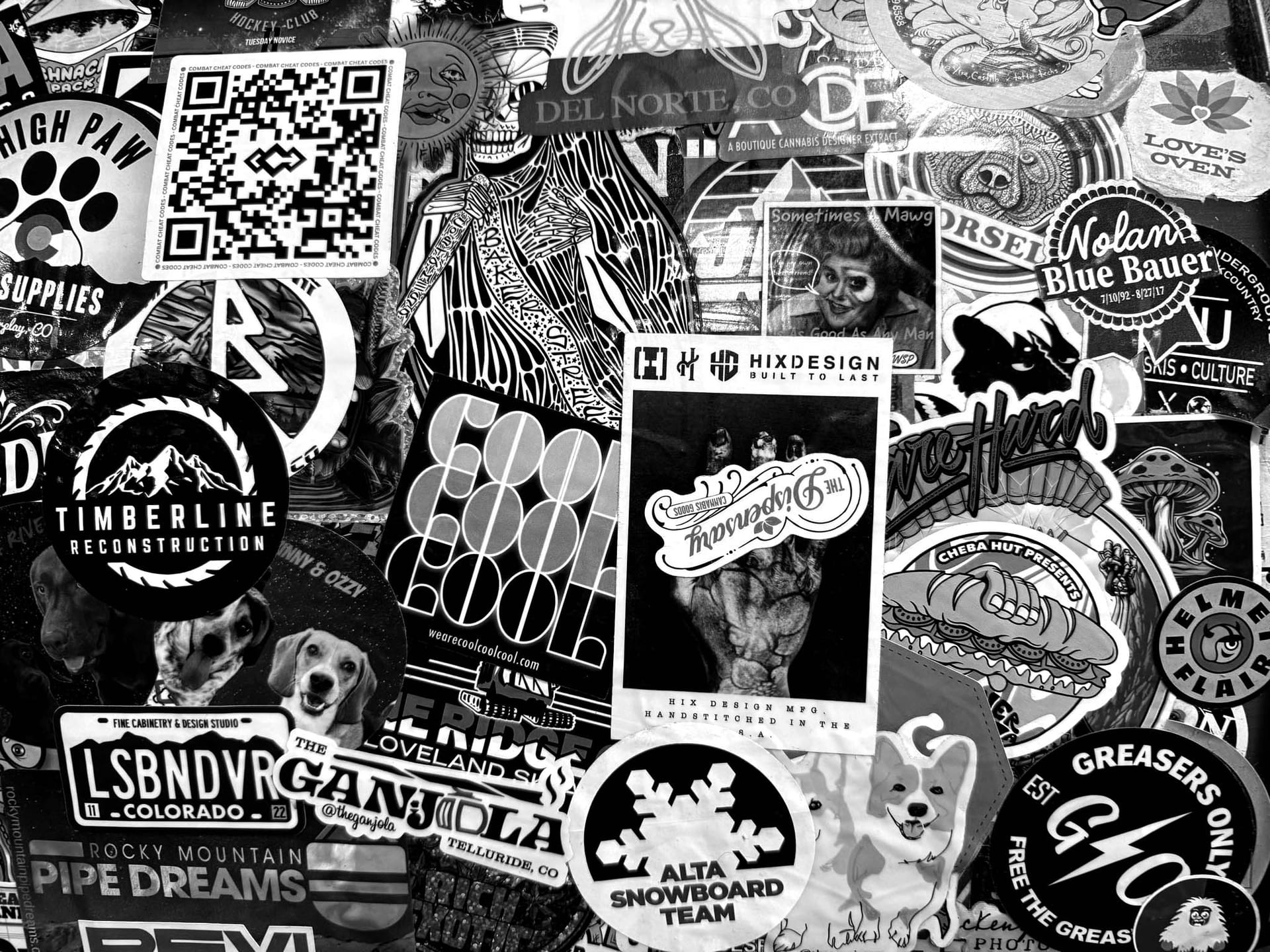
That felt right. Not because it was prettier. Because it was accumulated.
A sticker-bombed surface is evidence. People passed through. People left marks. Not all of them were good marks. Many were cheap. Some were funny by accident. Some aged badly. Some peeled at the corners. Some were completely covered by other stickers, so we'll never know. Over time the object became more itself because people touched it.
That is what I want the app to do. Not just store activity. Accumulate evidence.
Small things are not automatically trivial. Lunch is one of the more basic units of human civility. Feeding someone is basic in the deepest sense: not grand, not abstract, not especially noble, just one of the original ways people take care of each other. Remembering that you owe someone food is not justice in the cosmic sense, but it is a small refusal of the general drift toward indifference and abstraction.
The internet wants to turn every impulse into a market. Sandwich Bets turns one impulse into a joke with guardrails.
It does not solve gambling. It does not fix platforms. It does not end the casino logic of modern life. It will not prevent anyone from making terrible choices with real money somewhere else. It is not a revolution, though the revolution requires bread.
I don't make sandwich bets with people I dislike. That would be deranged. The whole thing depends on a basic level of affection, or at least durable goodwill. Without that, it is just a tiny debt with condiments.
That is what changes the meaning of the wager. The loser is not punished, exactly. The loser is given a reason to feed someone. The risk becomes an excuse for a small gesture. Someone (I) was wrong, someone was right, and somehow the result is lunch.
This is where the app starts to feel less like a bet tracker and more like a gifting system in disguise. The bet creates the reason. The ledger preserves the obligation. Fulfillment turns the whole thing back into what it probably was underneath: a way to be wrong and still be right.